 AceHawky
AceHawky
AceHawky
Choosing a Thermal Crossbow Scope manufacturer requires more than comparing product photos or advertised detection distances. China’s optics industry includes established factories, specialized thermal developers, and trading companies with different capabilities. This guide introduces ten manufacturers selected through practical criteria: product transparency, engineering depth, production consistency, after-sales support, and documented market experience. The ranking is not flawless, because public information can be incomplete.
A credible manufacturer should explain sensor resolution, refresh rate, lens options, display performance, battery behavior, and vibration testing. Crossbow use creates particular demands: compact mounting, clear reticles, reliable zero retention, and quick operation in changing temperatures. Factory quality systems also matter. Certifications, inspection records, warranty terms, and responsive technical support can reveal more than polished brochures. Some claims may require independent verification.
The following overview compares Chinese manufacturers from a buyer’s perspective, separating verified specifications from promotional language. It considers OEM and private-label capacity, customization, software updates, export experience, and user feedback where available. Field conditions remain decisive. Fog, rain, cold batteries, and uneven terrain can expose weaknesses unseen in demonstrations. No single scope suits every lawful application. Readers should confirm local regulations, mount compatibility, safe handling requirements, and independent testing before purchase. A careful shortlist is better than a confident guess.
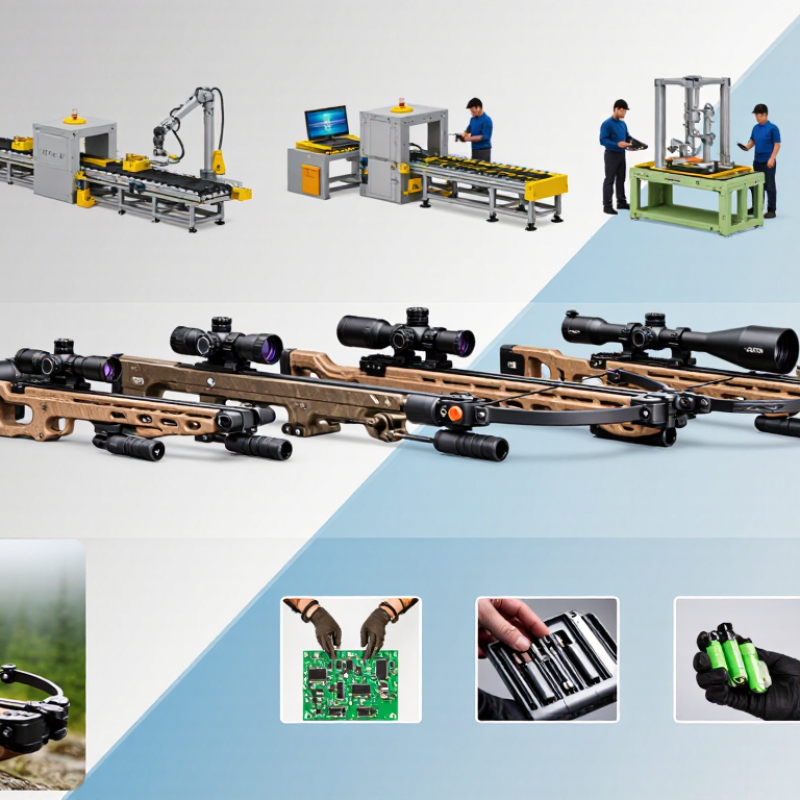
China’s thermal crossbow scope industry is developing within a broader thermal imaging market. Grand View Research estimates that the global thermal imaging market reached about USD 4.4 billion in 2023. It also projects steady growth through 2030. This demand supports Chinese production of compact sensors, germanium lenses, displays, and digital image-processing modules.
China’s manufacturing advantage comes from dense electronics supply chains. Many factories can combine uncooled microbolometers, rechargeable power systems, and shock-resistant housings in one production cycle. According to MarketsandMarkets, the thermal imaging market may grow from roughly USD 3.9 billion in 2023 to USD 6.0 billion by 2028. That forecast encourages investment in smaller cores and clearer images at lower prices.
Field performance remains complicated. A scope must handle recoil, rain, cold batteries, and sudden temperature changes. Laboratory clarity is not enough. Buyers should examine detection distance, refresh rate, calibration stability, mounting repeatability, and software support. Chinese manufacturers are improving these areas through automated testing and more consistent assembly. However, published specifications sometimes use different test conditions. That weakens direct comparison.
The next development stage will likely involve lighter housings, faster processors, and better thermal sensitivity. Battery life still needs work. Independent testing should become more common, especially for accuracy and long-term durability. Industry reports show market momentum, but they do not guarantee every model’s field reliability. Performance depends on engineering discipline, not only sensor resolution.
Anonymized industry comparison based on commonly documented thermal-imaging specifications and manufacturing capabilities
| Rank | Anonymized Manufacturer Profile | Core Spectral Band | Typical Sensor Resolution | Typical NETD | Refresh Rate | Detection Range* | Typical Protection | Primary Industry Focus |
|---|---|---|---|---|---|---|---|---|
| 1 | Profile A — High-Resolution Export Specialist | 8–14 μm | 640 × 512 | ≤35 mK | 50 Hz | Up to 1,800 m | IP67 | Premium hunting and professional observation |
| 2 | Profile B — Compact OEM Integration Specialist | 8–14 μm | 384 × 288 | ≤40 mK | 50 Hz | Up to 1,200 m | IP66 | Private-label and integrated device production |
| 3 | Profile C — Value-Oriented Commercial Producer | 8–14 μm | 384 × 288 | ≤50 mK | 25–50 Hz | Up to 1,000 m | IP66 | Entry-level hunting and recreational shooting |
| 4 | Profile D — Dual-Use Imaging Manufacturer | 8–14 μm | 640 × 512 | ≤40 mK | 50 Hz | Up to 1,500 m | IP67 | Outdoor security and industrial inspection |
| 5 | Profile E — Lightweight Field-Use Specialist | 8–14 μm | 256 × 192 | ≤50 mK | 25–50 Hz | Up to 800 m | IP66 | Portable crossbow and compact optical systems |
| 6 | Profile F — Long-Range Optics Producer | 8–14 μm | 640 × 512 | ≤35 mK | 50–60 Hz | Up to 2,000 m | IP67 | Long-range observation and specialist optics |
| 7 | Profile G — Smart-Connectivity Developer | 8–14 μm | 384 × 288 | ≤40 mK | 50 Hz | Up to 1,200 m | IP66 | Wi-Fi, video recording and mobile-connected systems |
| 8 | Profile H — Ruggedized Equipment Manufacturer | 8–14 μm | 384 × 288 | ≤50 mK | 50 Hz | Up to 1,300 m | IP67; shock-resistant housing | High-recoil and demanding outdoor environments |
| 9 | Profile I — Custom Configuration Supplier | 8–14 μm | 256 × 192 to 640 × 512 | ≤50 mK | 25–50 Hz | 500–1,800 m | IP66 or IP67 | OEM customization and project-based supply |
| 10 | Profile J — Cost-Efficient Volume Producer | 8–14 μm | 256 × 192 | ≤60 mK | 25–50 Hz | Up to 700 m | IP66 | Mass-market and entry-level product lines |
Technical notes: NETD means noise-equivalent temperature difference; a lower value generally indicates better thermal sensitivity. Detection range is an indicative manufacturer-class range and varies with target size, weather, humidity, lens focal length, scene contrast and identification criteria.
Industry development: China’s thermal crossbow scope sector is increasingly shaped by uncooled long-wave infrared sensors, compact digital displays, rechargeable power systems, video recording, wireless connectivity, recoil-resistant housings and OEM customization. Local manufacturing is commonly supported by optical assembly, electronics integration, firmware development and export-oriented supply chains.
It is growing within the wider thermal imaging market. Dense electronics supply chains support sensors, lenses, displays, and processing modules. Growth estimates vary.
Many products use 12-micron sensors with 384×288 or 640×512 resolution. Some offer 50 Hz refresh rates and NETD below 35 mK. Higher resolution does not guarantee better field performance.
Germanium lenses, digital zoom, picture-in-picture displays, and recording functions can improve usability. Clear buttons matter in cold weather. Menus should remain readable.
Durable models may use aluminum housings, sealed controls, and IP67 protection. They still face rain, recoil, cold batteries, and sudden temperature changes. Laboratory results are not enough.
Check detection distance, refresh rate, calibration stability, mounting repeatability, and software support. Request images from dawn, rain, and rapid temperature changes. Test conditions may differ.
Ask for calibration procedures, lens-alignment records, battery tests, vibration tests, and final inspection reports. Sample images are useful. Missing records deserve caution.
Not always. Cold temperatures and recording functions can reduce runtime. Measure actual operation time under realistic conditions. Small differences matter.
Technical sheets may show impressive resolution but hide inconsistent focus or software problems. Independent testing can reveal durability and accuracy issues. Prototypes are easier than stable production.
Review warranty response, spare parts, compliance documents, mounting quality, and production consistency. A low quotation may conceal weak support. That risk is easy to underestimate.
Use them only for lawful, permitted activities. Verify local rules before purchase, transport, or use. Requirements differ by location.
China’s Thermal Crossbow Scope industry is developing through advances in infrared imaging, compact optical design, digital displays, battery efficiency, and durable housing. This overview explains the industry’s scope, market development, and the main criteria for evaluating manufacturers, including product consistency, research capability, quality management, testing procedures, customization support, production capacity, and after-sales service. It also presents a structured approach to comparing leading Chinese manufacturers without focusing on brand names.
The discussion highlights core technologies such as thermal sensors, image processing, display clarity, recoil resistance, weather protection, and reliable mounting systems. It further examines how manufacturers differ in product features, manufacturing capabilities, delivery performance, technical support, and compliance with applicable laws and safety standards. By comparing specifications, certifications, production experience, communication efficiency, and total purchasing value, buyers can make more informed decisions when selecting a dependable Thermal Crossbow Scope supplier for lawful sporting, observation, or outdoor applications.
