 AceHawky
Choosing the best Tactical Range Scopes in 2026 means looking beyond magnification numbers. A clear image matters, but so do repeatable adjustments, usable reticles, dependable tracking, and low-light performance. At the range, a turret that shifts unpredictably can spoil careful work. Small details matter.
The NSSF’s 2024 Firearm Industry Economic Impact report estimated that the U.S. firearm and ammunition industry supported 384,000 jobs and generated $90.4 billion in economic activity. That figure describes the wider industry, not scope sales. It still offers useful context for a competitive market where product claims deserve careful scrutiny. It is not a scope-ranking metric.
Ballistician Bryan Litz is often credited with the reminder, “The bullet doesn’t know what rifle it came out of.” The line concerns ballistics, not scope selection, but it points to a practical lesson: reliable results depend on measured inputs. A scope cannot replace verified elevation data, consistent mounting, or practice.
This guide compares options by optical clarity, adjustment repeatability, reticle design, durability, and value. Specifications are useful. They are not the whole story. Real-world performance can vary with setup, ammunition, and the shooter’s experience, so no single model is best for everyone. Some comparisons also rely on limited public testing; that uncertainty should be stated, not hidden.
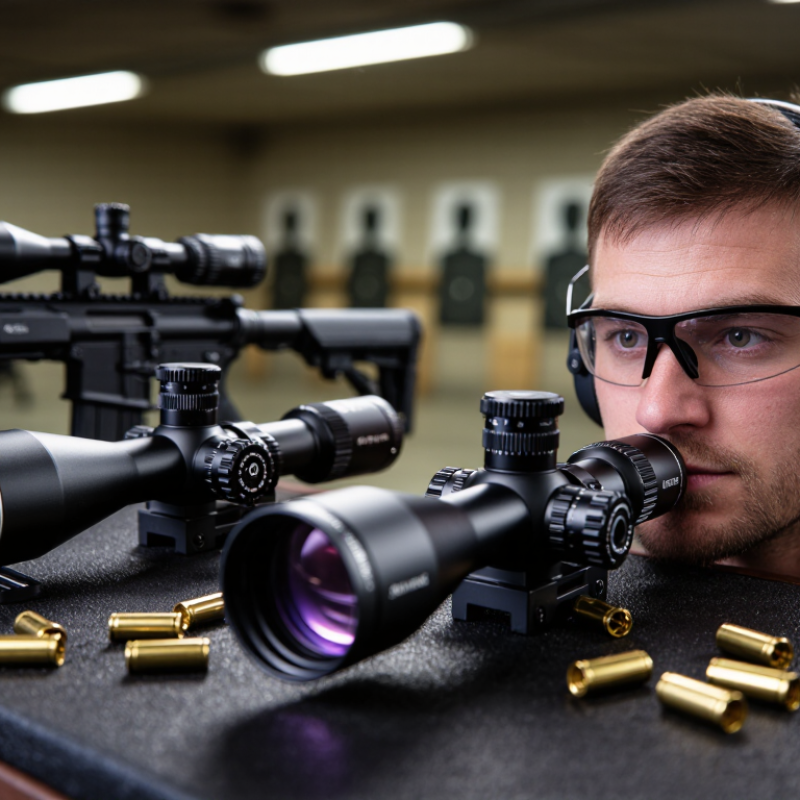
Define the mission before choosing magnification. A compact 1–6x or 2–10x optic suits close-to-midrange practice, where a wide view helps track moving paper targets and find the reticle quickly. For measured distances and small aiming points, 4–16x or 5–25x offers finer target detail, but higher power narrows the field of view and makes wobble more obvious. More magnification is not automatically better. Check eye relief, usable adjustment range, and whether the image remains clear at the power you actually use.
Focal-plane design changes how the reticle behaves. In a first-focal-plane scope, reticle marks retain their scale across magnification settings, which can simplify holdovers at different powers. In a second-focal-plane scope, those marks are accurate at a specified power; confirm that setting before relying on them. The 2024 Outdoor Industry Association Outdoor Participation Trends Report counted 175.8 million U.S. outdoor participants in 2023. That broad figure is not a scope-sales measure, so it cannot tell buyers which optic performs best. It does reinforce the need to match equipment to the activity, not a trend. Test controls with gloves, read the reticle against a plain target, and record the magnification that gives a steady, readable sight picture. I would reconsider any setup that feels impressive but slows basic adjustments.
Match magnification to the distance and target size. A 1–6x or 2–10x scope gives a wider view for nearby paper targets. A 4–16x or 5–25x scope shows smaller aiming points more clearly. Higher power also makes wobble easier to see.
A first-focal-plane reticle keeps its scale across magnification settings. A second-focal-plane reticle is accurate at a specified power. Check that setting before using its marks. Easy to overlook.
No. A 34 mm tube may offer more internal elevation adjustment, but diameter alone does not guarantee greater usable travel. Check the stated adjustment range and mount compatibility. Bigger is not automatically better.
Under ideal conditions, one click moves impact about 1 cm at 100 metres. At 1,000 metres, that is about 10 cm. Wind and setup can change actual results, so verify tracking with a measured test.
It depends on your distances, zero, mount height, and base angle. Advertised total travel may not remain available after zeroing. Compare the usable range, not just the largest number on the package.
Measure the rail, tube, and objective clearance before buying rings. Check ring height and mounting torque against the instructions. With the rifle unloaded, confirm room for lens caps and a comfortable cheek position. Small details matter.
Look for documented tracking tests and return-to-zero results after repeated shots. Check for stated water- and fog-resistance testing across temperature changes. Test conditions vary, so charts cannot predict every setup.
Try the controls with gloves and inspect the reticle in bright and dim light. Record magnification and any point-of-impact shift during a careful range evaluation. I might still choose wrong on paper; hands-on testing helps.
Choosing the best Tactical Range Scopes in 2026 starts with the intended mission and the distances you expect to cover. A 1–8× optic favors a wide field of view and quick target acquisition at shorter distances, while 3–18× offers a flexible balance for varied ranges. A 5–25× scope supports more detailed observation at longer distances, though its added magnification may come with greater size and weight. Focal-plane design matters too: first focal plane reticles keep hold references consistent as magnification changes, whereas second focal plane reticles remain visually steady but require attention to the magnification setting for accurate holds.
Compare tube size, adjustment units, and usable elevation travel with your setup rather than treating any one specification as decisive. A 30 mm or 34 mm tube, 0.1 mrad clicks, and sufficient elevation range should suit the rail, mounts, and intended adjustments. Match reticle units to your preferred MIL or MOA method, then assess tracking, recoil tolerance, weather resistance, fit, and credible test data before making a final choice.
